



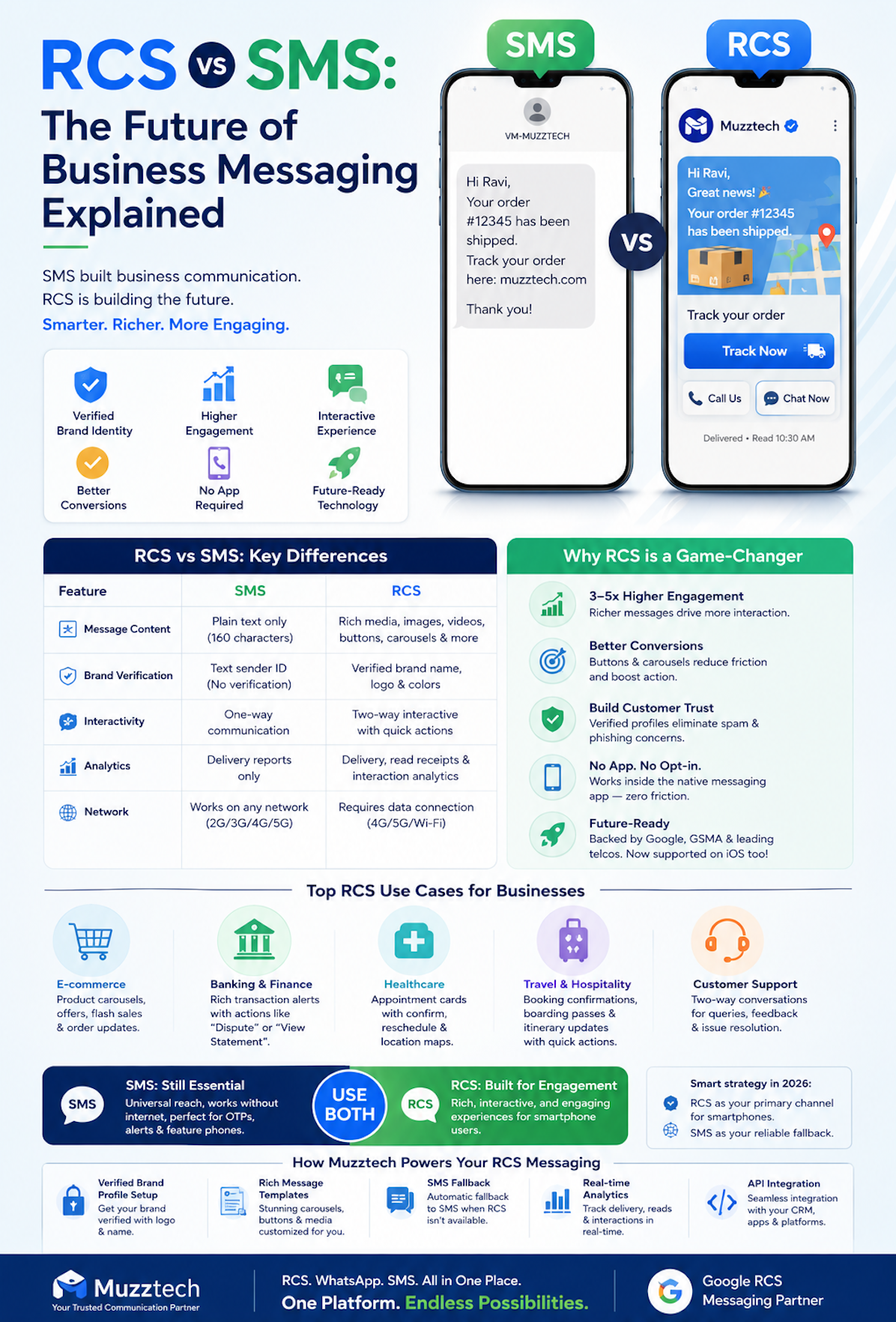
RCS vs SMS: The Future of Business Messaging Explained
For decades, SMS has been the backbone of business communication in India and across the globe. Simple, universal, and reliable — it just works. But in 2026, a powerful new messaging standard is rapidly changing what businesses can do with a text message. It is called RCS, or Rich Communication Services, and it is set to redefine how brands engage with their customers.
In this article, we will break down the key differences between RCS and SMS, explore what makes RCS the next big leap in business messaging, and explain how Muzztech's RCS messaging solution helps Indian businesses harness this technology today.
What is RCS Messaging?
RCS, or Rich Communication Services, is an advanced messaging protocol developed to succeed traditional SMS. Think of it as SMS — but upgraded with the rich features of apps like WhatsApp or iMessage, while still being delivered natively through your phone's default messaging app, without requiring a separate download.
RCS is backed by Google, major telecom carriers, and the GSMA (the global body governing mobile standards). In India, RCS is being rapidly adopted by leading telecom operators including Jio, Airtel, and Vi, making it increasingly accessible for businesses looking to upgrade their customer messaging.
With RCS, businesses can send:
-
High-resolution images and videos
-
Interactive buttons (call to action, quick replies)
-
Product carousels for showcasing multiple items
-
Verified brand sender IDs with logos
-
Read receipts and delivery confirmations
-
Location sharing and suggested actions
RCS vs SMS: A Side-by-Side Comparison
To truly understand why RCS is generating so much excitement, it helps to compare it directly with traditional SMS across the key parameters that matter most to businesses:
Message content
SMS: Plain text only, limited to 160 characters per message segment.
RCS: Supports rich media including images, videos, GIFs, PDFs, carousels, and interactive buttons — with no strict character limit.
Brand verification
SMS: Sender IDs are text strings (e.g., VM-MUZZTECH) with no visual verification for the recipient.
RCS: Messages display your verified brand name, logo, and colour — so customers instantly know the message is genuinely from your business, greatly reducing the risk of phishing.
Interactivity
SMS: Static one-way communication. The recipient reads the message but cannot interact with it directly.
RCS: Fully interactive. Recipients can tap buttons, browse product carousels, confirm appointments, make payments, and share location — all within the messaging interface.
Analytics and read receipts
SMS: Delivery reports only — you know the message was delivered but not whether it was read.
RCS: Provides delivery status, read receipts, and interaction analytics — so businesses know exactly how customers are engaging with each message.
Network requirement
SMS: Works on any mobile network, even 2G, with no internet connection required.
RCS: Requires a data connection (4G/5G/Wi-Fi). Where RCS is unsupported or no data is available, messages can automatically fall back to SMS.
Why RCS is a Game-Changer for Indian Businesses in 2026
India is one of the fastest-growing RCS markets in the world. With over 500 million smartphone users and rapidly expanding 5G coverage, the conditions are ideal for RCS adoption to accelerate dramatically in 2026 and beyond.
Here is why forward-thinking businesses are making the switch:
-
Higher engagement rates: RCS messages consistently achieve 3–5x higher engagement compared to plain SMS, because recipients can interact without leaving the message thread.
-
Better conversion: Interactive buttons and carousels reduce friction in the customer journey — a customer can browse a product, add it to cart, and confirm a purchase without opening a browser.
-
Increased trust: Verified brand profiles eliminate spoofing concerns and make customers more confident about engaging with your messages.
-
No app required: Unlike WhatsApp or other messaging apps, RCS works inside the native messages app — meaning zero friction for the recipient and no need for opt-ins to a third-party platform.
-
Future-proof investment: As Apple's iOS has now added RCS support globally (rolled out in late 2024), RCS is rapidly becoming a universal standard — making it the most future-ready messaging channel available today.
Top RCS Use Cases for Businesses
RCS is not just a technology upgrade — it is a new way of thinking about customer engagement. Here are some of the most impactful business use cases:
-
E-commerce: Send product carousels with images, prices, and "Buy Now" buttons directly in the message thread. Run flash sale campaigns with countdown timers.
-
Banking and finance: Send transaction alerts with rich details and action buttons like "Dispute this transaction" or "View statement" — all inside the message.
-
Healthcare: Share appointment cards with date, doctor details, and "Confirm" or "Reschedule" buttons. Include location maps directly in the message.
-
Travel and hospitality: Send boarding passes, hotel booking confirmations, and itinerary cards with rich visuals and quick-action buttons.
-
Customer support: Enable two-way conversational flows where customers can select options, escalate issues, or provide feedback — all without picking up the phone.
Should You Replace SMS with RCS?
The honest answer is: not entirely — at least not yet. SMS and RCS serve complementary roles in a well-rounded communication strategy.
SMS remains the gold standard for universal reach, OTP delivery, and communication to feature phones or low-connectivity areas. RCS, on the other hand, shines for rich promotional campaigns, interactive customer journeys, and brand-building experiences with smartphone users.
The smart approach in 2026 is to use both — with RCS as your primary channel for smartphone audiences and SMS as your reliable fallback. Muzztech's platform handles this seamlessly, automatically falling back to SMS when RCS is unavailable, so you never miss a customer.
How Muzztech Powers Your RCS Messaging
As an official Google RCS Messaging Partner, Muzztech provides businesses with everything they need to launch RCS campaigns quickly and compliantly. Our RCS messaging solution includes:
-
Verified brand profile setup: We handle the brand verification process with Google and telecom partners so your messages display your logo and name.
-
Rich message templates: Our team helps you design compelling carousels, buttons, and media-rich messages tailored to your campaign goals.
-
SMS fallback: When a recipient's device does not support RCS, our platform automatically sends an SMS version — so your message always gets through.
-
Real-time analytics: Track message delivery, read rates, and button interactions through our unified CPaaS dashboard.
-
API integration: Integrate RCS messaging directly into your CRM, marketing automation platform, or mobile app via our developer API.
Muzztech also offers Enhanced Messaging Packages that bundle RCS with WhatsApp Business API and Bulk SMS — giving you a unified omnichannel messaging strategy from a single platform.


