

• 1800120400400
  • 9044266522
  • This email address is being protected from spambots. You need JavaScript enabled to view it.

SMS Marketing Best Practices for Indian Businesses in 2026

With a 98% open rate and most messages read within three minutes of delivery, SMS remains one of the highest-performing marketing channels available to Indian businesses. Yet the gap between businesses that run mediocre SMS campaigns and those that achieve exceptional results — high click-through rates, strong conversions, and growing contact lists — comes down not to the channel itself, but to how well they use it.

In 2026, SMS marketing in India has matured significantly. Customers are more discerning, TRAI's regulatory framework is stricter, and the bar for what constitutes a genuinely effective SMS campaign has risen considerably. Generic, untargeted bulk SMS blasts no longer deliver the returns they once did. What works is a disciplined, customer-centric approach — the right message, to the right person, at the right time, through the right sender.

In this guide, we share the proven SMS marketing best practices that Muzztech's most successful clients apply to their campaigns — covering everything from copywriting and timing to segmentation, compliance, and measurement.

Best Practice 1: Craft Clear, Compelling SMS Copy

You have 160 characters — or 70 for Unicode regional language messages — to make an impression, communicate value, and prompt action. Every word must earn its place. The best-performing SMS messages follow a simple structure:

  • Hook (who you are and why you are messaging): Start with your brand name or a value-leading statement. Never assume the recipient immediately knows who is texting them.
  • Offer or value proposition (what's in it for them): State the benefit clearly and specifically — "30% off all electronics" outperforms "great deals this weekend" every time.
  • Urgency or scarcity (why act now): "Today only", "Ends midnight", "Only 50 units left" — create a genuine reason to act immediately rather than later.
  • Call to action (what to do next): Make the next step crystal clear and effortless — a short link to the offer page, a number to call, or a keyword to reply with.

Avoid jargon, ambiguity, and overly promotional language that might trigger spam filters. Write the way you would speak to a customer — conversational, specific, and respectful of their time.

Best Practice 2: Send at the Right Time

When you send an SMS is almost as important as what you say. TRAI mandates that promotional SMS can only be sent between 9 AM and 9 PM — but within that window, timing significantly impacts open and conversion rates.

Research-backed timing guidelines for Indian SMS campaigns:

  • Mid-morning (10 AM to 12 PM): Consistently among the highest-performing windows for promotional SMS — recipients have settled into their day but are not yet absorbed in lunch or afternoon work.
  • Early evening (5 PM to 7 PM): The post-work window sees strong engagement — particularly for e-commerce, food delivery, and entertainment offers as people transition from work to personal time.
  • Avoid Mondays: Monday mornings generate the weakest engagement as recipients deal with the start of the work week. Wednesday through Saturday tends to perform best for promotional campaigns.
  • Match timing to the offer: A lunch deal should be sent by 11:30 AM. A flash sale should be sent when it starts. A weekend offer should go out on Friday evening — not Monday morning when it is already half over.

Muzztech's platform includes AI-powered send-time optimisation — analysing your audience's historical engagement patterns to automatically select the best send time for each contact individually, rather than applying a one-size-fits-all schedule.

Best Practice 3: Segment Your Audience for Relevance

Sending the same message to your entire contact list is the single biggest mistake in SMS marketing. Relevance is the key driver of engagement — and relevance requires segmentation. Customers who receive messages that feel personally relevant are significantly more likely to click, convert, and stay subscribed.

Effective segmentation dimensions for Indian SMS campaigns include:

  • Purchase history: Segment customers by what they have bought previously and send offers for complementary or repeat-purchase products — not generic promotions unrelated to their interests.
  • Geographic location: Tailor messages to city-specific offers, local store openings, regional events, or regional language preferences.
  • Engagement recency: Separate active customers (purchased in the last 30 days), lapsing customers (31–90 days), and churned customers (90+ days) — each group needs a different message and incentive.
  • Customer lifecycle stage: New customers need onboarding and trust-building messages. Loyal customers need recognition and exclusive rewards. Churned customers need a compelling reason to return.
  • Language preference: Customers who prefer regional languages should receive messages in their native script — Hindi, Tamil, Telugu, or others — using Muzztech's Regional Language SMS capability.

Best Practice 4: Personalise Beyond the First Name

Basic personalisation — inserting the recipient's first name into the message — is table stakes in 2026. The SMS campaigns that truly stand out go further, using dynamic content to make each message feel genuinely tailored to the individual.

Advanced personalisation techniques that drive measurably higher engagement:

  • Product-specific messaging: Reference the specific product category or brand the customer has purchased or browsed — "Hi Rahul, your favourite Nike running shoes are now 20% off".
  • Loyalty and milestone recognition: "Congratulations Priya — you've reached Gold status. Here's your exclusive member offer." Recognition messages generate exceptional engagement.
  • Behaviour-triggered messages: Trigger SMS based on real-time customer actions — an abandoned cart, a completed purchase, a review submission — so the message arrives at the precise moment of relevance.
  • Location-based personalisation: Send offers relevant to the customer's city or pincode — especially powerful for businesses with physical stores or city-specific promotions.

Best Practice 5: Maintain a Clean, Consented Contact List

The quality of your SMS contact list directly determines the quality of your campaign results — and your compliance standing. A small list of genuinely opted-in, active contacts will always deliver better ROI than a large list padded with stale, unconsented, or invalid numbers.

Contact list best practices for Indian businesses:

  • Collect opt-in at the right moment: The best time to capture SMS consent is immediately after a positive interaction — at the point of purchase, during a service booking, or when a prospect downloads a resource from your website.
  • Keep consent records: Store a timestamped record of when and how each contact gave consent. Under TRAI regulations, this documentation may be required to demonstrate compliance.
  • Remove bounced and unsubscribed numbers promptly: Muzztech's platform automatically handles bounce removal and unsubscribe management — but you should also periodically audit your list to remove numbers that have not engaged in six months or more.
  • Never purchase contact lists: Purchased lists contain unconsented numbers, violate TRAI regulations, generate high complaint rates that damage your sender reputation, and ultimately deliver poor campaign results. Organic list-building is always worth the patience it requires.

Best Practice 6: A/B Test Relentlessly

The most effective SMS marketers do not guess what works — they test it. A/B testing (sending two variants of a message to separate segments of your audience and comparing results) is one of the most powerful tools available for continuously improving SMS campaign performance.

High-value elements to A/B test in your SMS campaigns:

  • Opening line: Does leading with the brand name or the offer perform better for your audience?
  • Offer framing: "Get Rs 500 off" vs "Save 20%" — the same offer framed differently can produce meaningfully different conversion rates.
  • CTA wording: "Click here" vs "Shop now" vs "Claim your offer" — small changes in CTA language can significantly impact click-through rates.
  • Send time: Test mid-morning vs evening sends to identify which window performs better for your specific audience segment.
  • Regional language vs English: For mixed urban-rural audiences, test whether the regional language version outperforms English — the results may surprise you.

Best Practice 7: Measure What Matters and Optimise Continuously

Every SMS campaign you send is a source of data that should inform your next one. Muzztech's campaign dashboard tracks the key metrics that matter — delivery rate, click-through rate (via URL shortener tracking), opt-out rate, and conversion rate — in real time.

Key SMS marketing metrics every Indian business should track:

  • Delivery rate: The percentage of sent messages successfully delivered. A delivery rate below 90% suggests list quality issues or sender ID problems.
  • Click-through rate (CTR): Measured via short link tracking — the percentage of recipients who clicked the link in your message. Industry benchmarks vary, but a CTR above 5% is considered strong for promotional SMS in India.
  • Opt-out rate: The percentage of recipients who unsubscribed after the campaign. A high opt-out rate signals that the message was poorly targeted, irrelevant, or too frequent.
  • Revenue attributed: For e-commerce businesses — the direct revenue generated by the campaign, calculated by tracking purchases made within a defined window after the SMS was sent.
Regional Language SMS: Reach India's Bharat with Vernacular Messaging

India is not one market — it is hundreds of markets, each with its own language, culture, and consumer behaviour. While English and Hindi dominate urban digital communication, the real growth story of Indian business is happening in Bharat — the vast, vibrant, multilingual heartland of Tier 2, Tier 3, and rural India, where customers think, dream, and make purchasing decisions in their mother tongue.

For businesses looking to genuinely connect with this audience, the language of communication is not a detail — it is a strategy. A bulk SMS message sent in Hindi, Tamil, Telugu, Marathi, or Bangla does not just convey information; it signals respect, familiarity, and cultural belonging. It turns a transaction into a relationship.

In this guide, we explore why regional language SMS matters more than ever in 2026, which languages have the greatest reach, how vernacular messaging works technically, and how Muzztech's Regional Language SMS service helps Indian businesses break the language barrier and unlock the full potential of the Bharat market.

Why Regional Language SMS is a Business Imperative in 2026

The numbers tell a compelling story. According to research by the Internet and Mobile Association of India (IAMAI) and various digital economy reports, over 600 million of India's internet users primarily consume content in regional languages rather than English. This figure is growing faster than the English-language user base — driven by affordable smartphones, low-cost data, and government digital literacy programmes reaching deep into rural India.

For SMS specifically, the case for regional language communication is even stronger:

  • Higher open and read rates: Recipients are significantly more likely to read and act on a message written in their native language. A promotional SMS in Tamil resonates far more deeply with a Tamil-speaking customer than the same message in English.

  • Greater comprehension and trust: Regional language messages are easier to understand for recipients with limited English literacy — reducing confusion, increasing trust, and improving response rates.

  • Competitive differentiation: Most businesses default to English or Hindi for their SMS campaigns. Communicating in a customer's mother tongue is still relatively rare — making it a powerful differentiator that signals genuine local commitment.

  • Unlocking Tier 2 and Tier 3 growth: The next wave of Indian consumer spending is coming from non-metro cities and rural areas — markets where vernacular communication is not optional but essential for effective engagement.

India's Language Landscape: Key Regional Languages for SMS Campaigns

India has 22 scheduled languages and hundreds of dialects. For business SMS campaigns, the languages with the largest addressable audiences are:

  • Hindi: The most widely spoken language in India with over 500 million speakers, dominant across Uttar Pradesh, Madhya Pradesh, Rajasthan, Bihar, Haryana, Uttarakhand, and Delhi NCR.

  • Bengali (Bangla): Spoken by over 100 million people in West Bengal, Assam, and Jharkhand — India's second most spoken language and a rapidly growing digital market.

  • Telugu: The primary language of Andhra Pradesh and Telangana, with over 85 million speakers and one of India's fastest-growing e-commerce and fintech markets.

  • Marathi: The official language of Maharashtra — India's largest economy by state GDP — with over 80 million speakers across a highly active consumer market.

  • Tamil: Spoken by over 75 million people in Tamil Nadu and Puducherry, with a sophisticated, brand-conscious consumer base and strong digital penetration.

  • Kannada: The language of Karnataka — home to Bengaluru, India's tech capital — with over 45 million speakers and a highly digitally-engaged audience.

  • Gujarati: Spoken by over 55 million people in Gujarat and communities across India, with one of the country's most active trading and business communities.

  • Malayalam, Odia, Punjabi: Each with tens of millions of speakers across Kerala, Odisha, and Punjab/Haryana respectively — all significant and underserved regional markets for vernacular SMS.

Muzztech's Regional Language SMS service supports all of the above languages and more — delivered through our high-availability SMS gateway with full TRAI-DLT compliance.

How Regional Language SMS Works: Unicode and Beyond

Sending SMS in regional Indian languages involves a technical standard called Unicode — a universal encoding system that represents characters from virtually every writing system in the world, including Devanagari (Hindi, Marathi), Tamil script, Telugu script, Kannada script, and others.

There are a few key technical points businesses need to understand about regional language SMS:

Message length

Standard ASCII SMS messages (English) support 160 characters per segment. Unicode messages (used for regional language scripts) support 70 characters per segment. This means regional language SMS messages will use more message segments than equivalent English messages. Muzztech's platform automatically handles Unicode encoding and accurately calculates message segment counts before sending.

Device compatibility

The vast majority of mobile phones sold in India today — including affordable Android smartphones — fully support Unicode and can display regional language SMS messages correctly. Even many basic feature phones support Hindi (Devanagari) display. Muzztech's gateway automatically handles encoding to ensure maximum compatibility across all device types.

DLT template registration for regional language SMS

Regional language message templates must be registered on the DLT platform exactly as they will be sent — in the regional script, with correct Unicode encoding. Muzztech's compliance team handles template registration for all regional language campaigns, ensuring your messages are approved and delivered without blocking.

High-Impact Use Cases for Regional Language SMS

Regional language SMS delivers its greatest impact in use cases where comprehension, trust, and cultural relevance are critical:

  • FMCG and rural FMCG marketing: Promotional campaigns in local languages dramatically outperform English or even Hindi messages in regional markets — driving higher footfall to kirana stores and rural retail points.

  • Microfinance and rural banking: Loan repayment reminders, account balance alerts, and EMI notifications sent in the borrower's native language see significantly lower default rates — because the information is clearly understood.

  • Agriculture and agri-tech: Weather alerts, crop advisory messages, market price notifications, and government scheme announcements sent in regional languages to farmers are far more actionable than the same content in English.

  • Healthcare in Tier 2 and Tier 3 cities: Appointment reminders, medication adherence messages, and vaccination alerts in the patient's native language see higher response and follow-through rates.

  • Government and public services: TRAI-compliant public awareness campaigns, scheme notifications, and voter information messages in regional languages ensure information reaches citizens in a form they can understand and act on.

  • E-commerce in non-metro markets: Order confirmation, delivery update, and return process messages in the customer's native language reduce confusion, decrease customer service calls, and improve satisfaction scores.

Muzztech's Regional Language SMS Service: Key Features

Muzztech's Regional Language SMS capability is fully integrated into our Bulk SMS platform — meaning you access vernacular messaging through the same dashboard, API, and compliance framework you already use for English SMS campaigns:

  • Support for 10+ Indian languages: Hindi, Bengali, Telugu, Marathi, Tamil, Kannada, Gujarati, Malayalam, Odia, Punjabi, and more — all supported natively within the Muzztech platform.

  • Automatic Unicode encoding: Our system handles the technical encoding automatically — you simply compose your message in the regional language and we take care of the rest.

  • DLT-compliant template management: Our compliance team registers your regional language templates on the DLT platform and manages ongoing template updates.

  • Accurate segment count preview: The Muzztech dashboard shows you exactly how many message segments your regional language message will consume before you send — avoiding billing surprises.

  • Language-based contact segmentation: Segment your contact database by preferred language and send the appropriate language version to each segment automatically.

  • Pan-India delivery through multi-operator routing: Regional language SMS is delivered through Muzztech's high-availability gateway with multi-operator routing — ensuring maximum reach across all telecom networks in all states.

Best Practices for Regional Language SMS Campaigns

To get the most from your vernacular SMS campaigns, keep these best practices in mind:

  • Use native script — not transliteration: Send messages in the actual script of the language (Devanagari for Hindi, Tamil script for Tamil) rather than phonetic transliteration in Roman characters. Native script messages perform significantly better in terms of comprehension and engagement.

  • Keep messages concise: Unicode's 70-character limit per segment means regional language messages can get expensive if they are too long. Keep your message to the essential information to minimise segment count.

  • Have copy reviewed by a native speaker: Machine translation can produce unnatural or even misleading text. Always have your regional language SMS copy reviewed and approved by a fluent native speaker before launching a campaign.

  • Segment by language preference: Do not assume all customers in a state prefer one language. Collect language preference data at opt-in and use it to personalise language selection at the individual level.

  • A/B test language versions: Where possible, test regional language vs English versions of the same campaign to quantify the engagement uplift from vernacular messaging for your specific audience.


TRAI Regulations on Bulk SMS: What Every Business Must Know in 2026

If your business sends commercial SMS messages in India — whether for promotions, OTPs, transactional alerts, or any other purpose — you are operating under one of the world's most comprehensive regulatory frameworks for business messaging. The Telecom Regulatory Authority of India (TRAI) has put in place a detailed set of rules that govern how, when, and to whom businesses can send SMS. Non-compliance is not merely a technical risk — it results in message blocking, financial penalties, and reputational damage.

This guide explains TRAI's bulk SMS regulations in plain language, walks you through what your business needs to do to stay compliant in 2026, and shows how Muzztech makes compliance straightforward for businesses of every size.

Background: Why TRAI Regulates Bulk SMS

India's mobile messaging ecosystem handles billions of commercial SMS messages every month. Left unregulated, this creates significant problems — spam, phishing, financial fraud, and consumer harassment. TRAI has been progressively tightening its regulatory framework since 2010, with the most significant overhaul coming in 2019 through the introduction of the Distributed Ledger Technology (DLT) framework.

Today, every business sending commercial SMS in India must comply with TRAI's Telecom Commercial Communications Customer Preference Regulations (TCCCPR), which cover everything from sender ID registration and message template approval to consumer consent and DND (Do Not Disturb) compliance.

In 2026, TRAI's enforcement has become more rigorous than ever. Real-time traffic scrubbing by telecom operators means non-compliant messages are blocked before they even reach the recipient — making compliance not just a legal obligation, but a business necessity.

The DLT Framework: The Foundation of TRAI SMS Compliance

The DLT (Distributed Ledger Technology) platform is a blockchain-based system mandated by TRAI to register and authenticate all entities involved in commercial messaging — senders, telecom operators, and aggregators like Muzztech. The DLT platform creates an immutable, tamper-proof record of every commercial messaging participant and their approved content.

Every business sending commercial SMS in India must register on one of the TRAI-approved DLT platforms operated by telecom providers (such as Jio, Airtel, Vi, BSNL, or MTNL). Registration involves three key components:

1. Entity registration

Your business entity must be registered on the DLT platform with your company name, GST number, PAN, and other details. This establishes your business as a legitimate, verified commercial SMS sender in India.

2. Sender ID (Header) registration

Every commercial SMS must be sent from a registered 6-character alphabetic sender ID (for example, VM-MUZZTECH or TM-MYBIZ). Your sender ID must be registered on the DLT platform and linked to your entity. Unregistered sender IDs are blocked by telecom operators automatically.

3. Message template registration

Every message content format you intend to send must be registered as a template on the DLT platform before use. Templates define the fixed and variable parts of your message. Any message that does not match a registered template — even slightly — will be blocked. Each template is classified into a category: Transactional, Promotional, Service Implicit, or Service Explicit.

TRAI's Four SMS Message Categories Explained

TRAI classifies all commercial SMS into four categories, each with different rules around delivery hours, DND applicability, and consent requirements:

Transactional SMS

These are messages sent by banks, financial institutions, insurance companies, and other TRAI-notified sectors to deliver critical service information — such as OTPs, account debits, and transaction alerts. Transactional SMS can be sent 24/7 to all numbers, including DND-registered ones, and do not require consumer opt-in.

Promotional SMS

Messages sent for marketing and advertising purposes — product launches, discount offers, and event announcements. Promotional SMS can only be sent between 9 AM and 9 PM and must not be sent to numbers registered on the DND list. Recipients must have given consent to receive marketing messages.

Service Explicit SMS

These are service-related messages sent only to customers who have explicitly opted in to receive communication from your business. Examples include membership updates, loyalty programme notifications, and service renewal alerts. Delivery is permitted 24/7 to opted-in numbers only.

Service Implicit SMS

Messages related to a service the customer is already using — for example, appointment reminders from a clinic, delivery updates from a logistics provider, or booking confirmations from a travel platform. These messages do not require explicit opt-in and can be sent 24/7, but they must be directly related to a service the customer has subscribed to or is actively using.

Understanding DND (Do Not Disturb) Rules

India's National Do Not Call Registry (NDNC), commonly referred to as the DND list, allows mobile users to register their numbers to block unsolicited commercial calls and SMS. TRAI's regulations strictly prohibit sending Promotional SMS to DND-registered numbers.

Key DND rules businesses must follow:

  • Promotional SMS must not be sent to fully DND-registered numbers (category 0 — block all commercial communication).

  • Consumers can register on the DND list via SMS, the telecom provider's app, or the TRAI website. Registration typically takes effect within 24 hours.

  • Transactional and Service SMS can be sent to DND numbers where permitted under TRAI's category rules.

  • Businesses must scrub their contact lists against the DND database before sending any Promotional SMS campaign. Muzztech's platform performs this scrubbing automatically before every promotional send.

Consumer Consent: The New Compliance Frontier

TRAI's TCCCPR regulations place increasing importance on consumer consent as the basis for commercial communication. In 2026, businesses must be able to demonstrate that recipients of promotional and service-explicit messages have provided valid, recorded consent.

Consent must be:

  • Explicit and unambiguous — pre-ticked boxes or assumed consent do not qualify.

  • Specific to the category of communication — consent for transactional messages does not extend to promotional messages.

  • Recorded and time-stamped — businesses must maintain an auditable consent record.

  • Revocable — consumers must be able to withdraw consent at any time, and businesses must honour opt-out requests promptly.

Common TRAI Compliance Violations — and How to Avoid Them

Understanding where businesses typically go wrong helps you stay on the right side of TRAI regulations:

  • Sending unregistered templates: Even a minor deviation from a registered template — such as adding a word or changing punctuation — will cause the message to be blocked. Always use exact registered templates and update them on DLT before making any changes.

  • Using unregistered sender IDs: Sending from a sender ID that is not registered on DLT results in automatic message blocking. Register all sender IDs in advance.

  • Sending promotional SMS outside permitted hours: Promotional messages sent before 9 AM or after 9 PM violate TRAI rules regardless of content. Use a scheduling tool that enforces permitted delivery windows.

  • Sending promotional SMS to DND numbers: Failure to scrub contact lists against the DND registry before promotional sends is one of the most common and consequential violations.

  • Misclassifying message categories: Sending a promotional message under a Transactional or Service category to bypass DND restrictions is a serious violation that can result in heavy penalties and blacklisting of your sender ID.

How Muzztech Keeps Your SMS Campaigns TRAI-Compliant

Navigating TRAI's regulations can be daunting, especially for businesses that are not communication specialists. Muzztech's platform is built from the ground up to handle compliance automatically — so you can focus on your campaigns, not the paperwork.

  • DLT onboarding assistance: Muzztech's team guides you through entity registration, sender ID setup, and template registration on the DLT platform — including helping you draft compliant template formats.

  • Automatic DND scrubbing: Before every promotional campaign, Muzztech's platform automatically filters your contact list against the live DND registry — removing non-eligible numbers without any manual effort from your team.

  • Template compliance check: Our system validates every message against your registered DLT templates before sending — flagging any content mismatch before it reaches the gateway.

  • Delivery window enforcement: Promotional messages are automatically held and sent within the TRAI-permitted 9 AM–9 PM window — even if you schedule them outside those hours.

  • Consent management tools: Muzztech provides opt-in and opt-out management tools so you can record, store, and honour consumer consent in line with TRAI's requirements.


RCS vs SMS: The Future of Business Messaging Explained

RCS vs SMS: The Future of Business Messaging Explained

For decades, SMS has been the backbone of business communication in India and across the globe. Simple, universal, and reliable — it just works. But in 2026, a powerful new messaging standard is rapidly changing what businesses can do with a text message. It is called RCS, or Rich Communication Services, and it is set to redefine how brands engage with their customers.

In this article, we will break down the key differences between RCS and SMS, explore what makes RCS the next big leap in business messaging, and explain how Muzztech's RCS messaging solution helps Indian businesses harness this technology today.

What is RCS Messaging?

RCS, or Rich Communication Services, is an advanced messaging protocol developed to succeed traditional SMS. Think of it as SMS — but upgraded with the rich features of apps like WhatsApp or iMessage, while still being delivered natively through your phone's default messaging app, without requiring a separate download.

RCS is backed by Google, major telecom carriers, and the GSMA (the global body governing mobile standards). In India, RCS is being rapidly adopted by leading telecom operators including Jio, Airtel, and Vi, making it increasingly accessible for businesses looking to upgrade their customer messaging.

With RCS, businesses can send:

  • High-resolution images and videos

  • Interactive buttons (call to action, quick replies)

  • Product carousels for showcasing multiple items

  • Verified brand sender IDs with logos

  • Read receipts and delivery confirmations

  • Location sharing and suggested actions

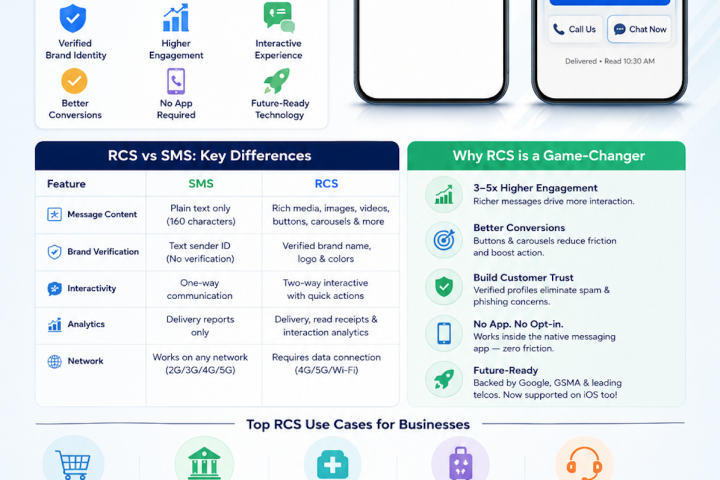
RCS vs SMS: A Side-by-Side Comparison

To truly understand why RCS is generating so much excitement, it helps to compare it directly with traditional SMS across the key parameters that matter most to businesses:

Message content

SMS: Plain text only, limited to 160 characters per message segment.

RCS: Supports rich media including images, videos, GIFs, PDFs, carousels, and interactive buttons — with no strict character limit.

Brand verification

SMS: Sender IDs are text strings (e.g., VM-MUZZTECH) with no visual verification for the recipient.

RCS: Messages display your verified brand name, logo, and colour — so customers instantly know the message is genuinely from your business, greatly reducing the risk of phishing.

Interactivity

SMS: Static one-way communication. The recipient reads the message but cannot interact with it directly.

RCS: Fully interactive. Recipients can tap buttons, browse product carousels, confirm appointments, make payments, and share location — all within the messaging interface.

Analytics and read receipts

SMS: Delivery reports only — you know the message was delivered but not whether it was read.

RCS: Provides delivery status, read receipts, and interaction analytics — so businesses know exactly how customers are engaging with each message.

Network requirement

SMS: Works on any mobile network, even 2G, with no internet connection required.

RCS: Requires a data connection (4G/5G/Wi-Fi). Where RCS is unsupported or no data is available, messages can automatically fall back to SMS.

Why RCS is a Game-Changer for Indian Businesses in 2026

India is one of the fastest-growing RCS markets in the world. With over 500 million smartphone users and rapidly expanding 5G coverage, the conditions are ideal for RCS adoption to accelerate dramatically in 2026 and beyond.

Here is why forward-thinking businesses are making the switch:

  • Higher engagement rates: RCS messages consistently achieve 3–5x higher engagement compared to plain SMS, because recipients can interact without leaving the message thread.

  • Better conversion: Interactive buttons and carousels reduce friction in the customer journey — a customer can browse a product, add it to cart, and confirm a purchase without opening a browser.

  • Increased trust: Verified brand profiles eliminate spoofing concerns and make customers more confident about engaging with your messages.

  • No app required: Unlike WhatsApp or other messaging apps, RCS works inside the native messages app — meaning zero friction for the recipient and no need for opt-ins to a third-party platform.

  • Future-proof investment: As Apple's iOS has now added RCS support globally (rolled out in late 2024), RCS is rapidly becoming a universal standard — making it the most future-ready messaging channel available today.

Top RCS Use Cases for Businesses

RCS is not just a technology upgrade — it is a new way of thinking about customer engagement. Here are some of the most impactful business use cases:

  • E-commerce: Send product carousels with images, prices, and "Buy Now" buttons directly in the message thread. Run flash sale campaigns with countdown timers.

  • Banking and finance: Send transaction alerts with rich details and action buttons like "Dispute this transaction" or "View statement" — all inside the message.

  • Healthcare: Share appointment cards with date, doctor details, and "Confirm" or "Reschedule" buttons. Include location maps directly in the message.

  • Travel and hospitality: Send boarding passes, hotel booking confirmations, and itinerary cards with rich visuals and quick-action buttons.

  • Customer support: Enable two-way conversational flows where customers can select options, escalate issues, or provide feedback — all without picking up the phone.

Should You Replace SMS with RCS?

The honest answer is: not entirely — at least not yet. SMS and RCS serve complementary roles in a well-rounded communication strategy.

SMS remains the gold standard for universal reach, OTP delivery, and communication to feature phones or low-connectivity areas. RCS, on the other hand, shines for rich promotional campaigns, interactive customer journeys, and brand-building experiences with smartphone users.

The smart approach in 2026 is to use both — with RCS as your primary channel for smartphone audiences and SMS as your reliable fallback. Muzztech's platform handles this seamlessly, automatically falling back to SMS when RCS is unavailable, so you never miss a customer.

How Muzztech Powers Your RCS Messaging

As an official Google RCS Messaging Partner, Muzztech provides businesses with everything they need to launch RCS campaigns quickly and compliantly. Our RCS messaging solution includes:

  • Verified brand profile setup: We handle the brand verification process with Google and telecom partners so your messages display your logo and name.

  • Rich message templates: Our team helps you design compelling carousels, buttons, and media-rich messages tailored to your campaign goals.

  • SMS fallback: When a recipient's device does not support RCS, our platform automatically sends an SMS version — so your message always gets through.

  • Real-time analytics: Track message delivery, read rates, and button interactions through our unified CPaaS dashboard.

  • API integration: Integrate RCS messaging directly into your CRM, marketing automation platform, or mobile app via our developer API.

Muzztech also offers Enhanced Messaging Packages that bundle RCS with WhatsApp Business API and Bulk SMS — giving you a unified omnichannel messaging strategy from a single platform.